System installation pricing for businesses that need real operating infrastructure.
System installation pricing at MAVLINX is not a decorative website quote. It is a commercial decision model for businesses that need routing, qualification, CRM structure, funnel logic, and operational clarity installed behind demand. This page exists to help serious buyers understand budget bands, filter mismatched expectations, and move into the right next step through Get My Recommendation.
Most quotes fail because they price pages, not the system load.
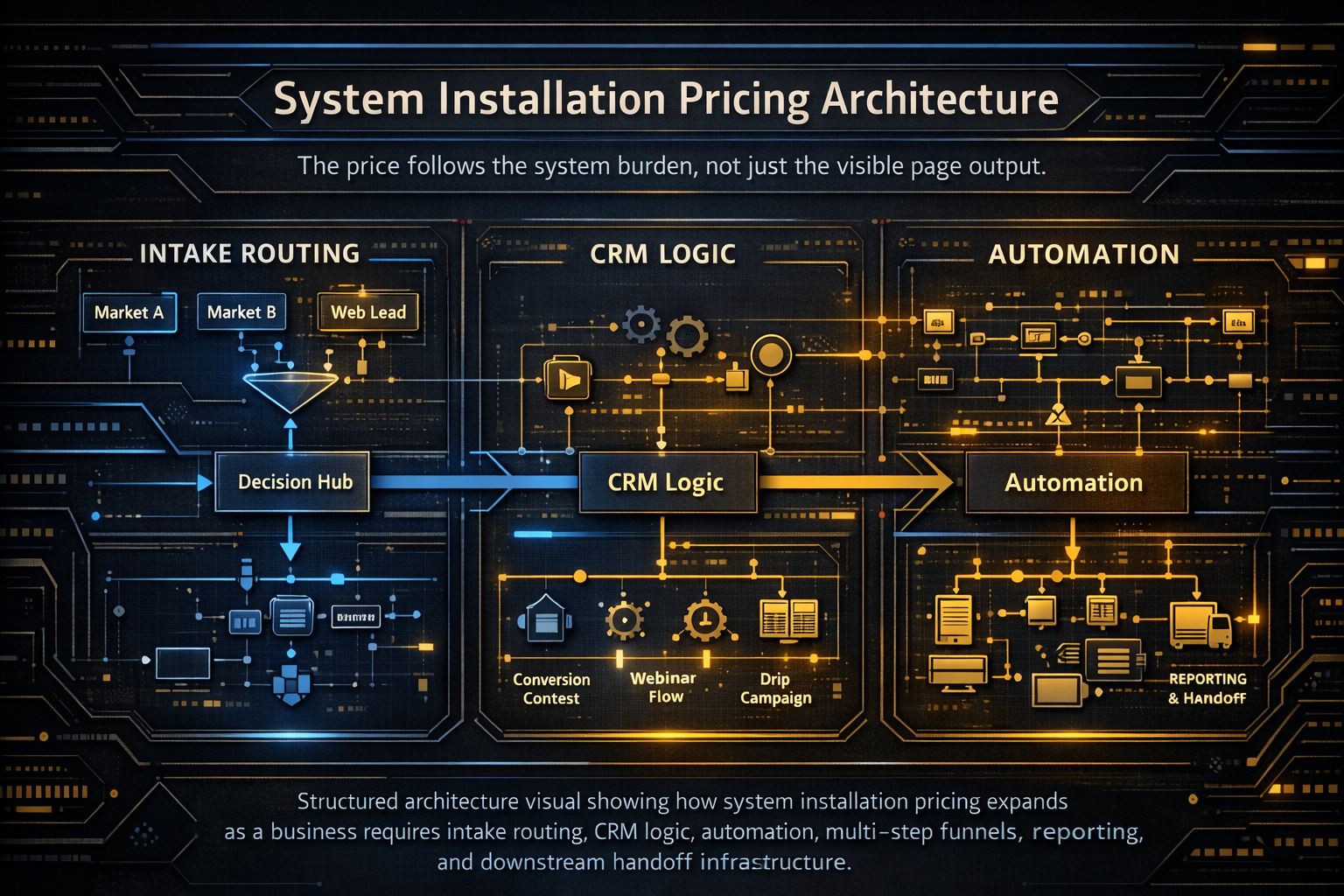
A business usually arrives at a pricing page wanting a number. That is reasonable. The problem is that most pricing in the market hides the real commercial variable. The visible page output is rarely the true cost driver. The real cost sits in what the business needs underneath the interface: routing logic, qualification paths, CRM architecture, follow-up automation, form handling, operational handoff, analytics, and failure prevention.
That is why MAVLINX uses system installation pricing instead of flat brochure pricing. Two businesses may each want a “website,” but one may need simple decision routing while the other needs a full install layer connecting intake, lead triage, operational workflow, and revenue logic. Those are not the same job, and pretending they are is how businesses buy the wrong thing.
MAVLINX prices the system that must be installed, not the illusion that must be shown.
The goal of this pricing philosophy is simple: stop attracting buyers who want vague low-cost output and instead qualify businesses that understand the link between commercial pressure and system design. System installation pricing is based on five practical variables: the clarity of your offer, the number of user states that must be handled, the depth of routing logic, the amount of CRM and automation burden, and the operational consequences of getting the build wrong. When those variables stay light, price stays controlled. When those variables rise, pricing rises because the business is asking for more infrastructure, more safeguards, and more decision architecture.
01 — Offer Clarity
A clear offer reduces system burden.
Businesses that know exactly what they sell, to whom, and what action matters next require less qualification architecture and less corrective messaging.
02 — Routing Complexity
More buyer states mean more logic.
If traffic must be separated by stage, readiness, service need, or geography, the installation becomes a routing problem rather than a page problem.
03 — Operational Weight
Backend load changes the price fast.
CRM structure, automations, handoff fields, reporting, and funnel logic all add real implementation depth to system installation pricing.
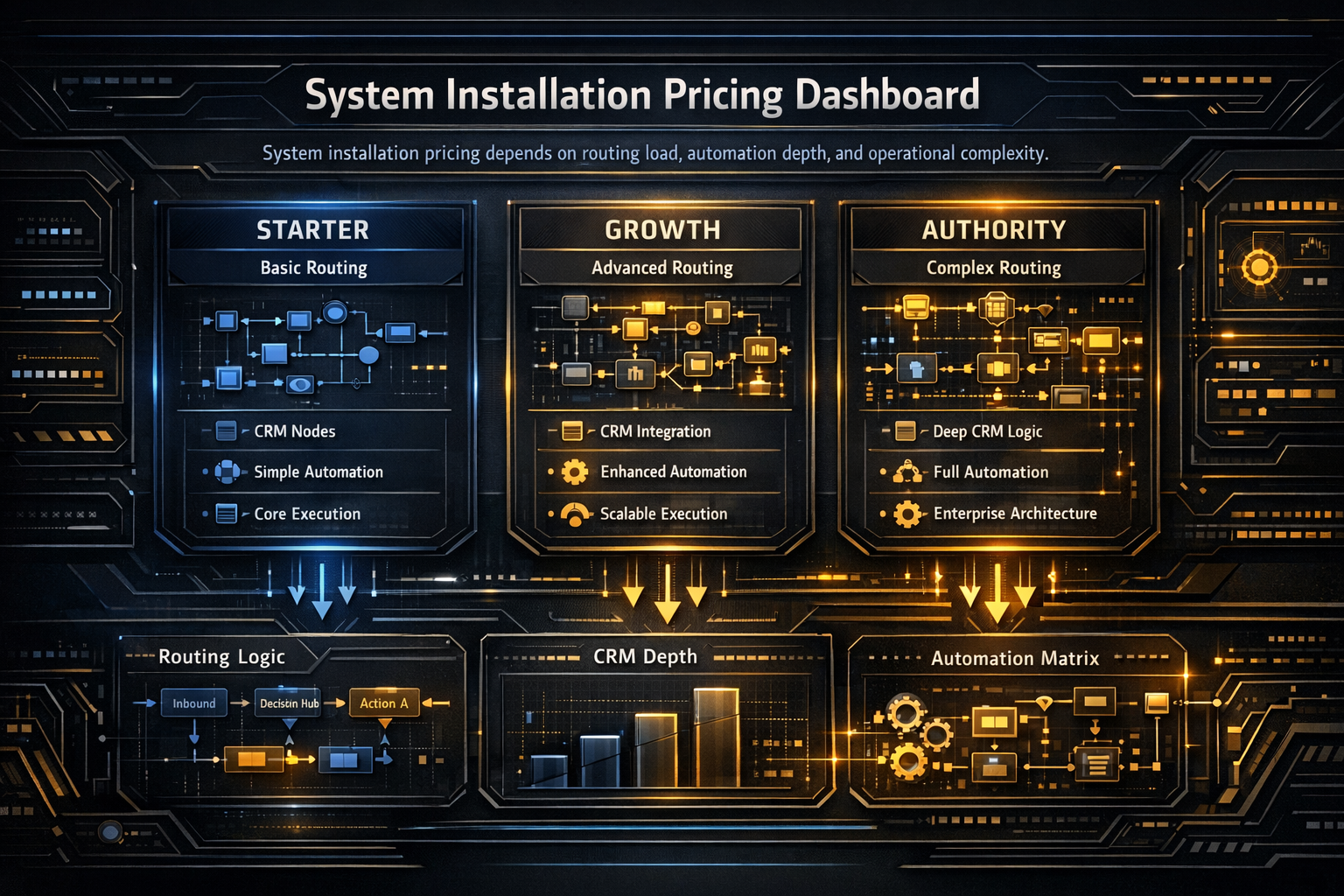
Choose the package that matches your current system burden, not your ego.
The package ladder below is designed to make pricing legible. It is not there to force everyone upward. Starter fits lower-complexity businesses that need controlled clarity. Growth fits operating businesses with meaningful lead flow and visible leakage. Authority fits businesses that need the page layer to work as a real operating surface for routing, qualification, and execution. If you are unsure, the correct next step is not guessing. It is using the recommendation funnel so scope can be mapped properly.
Starter
From $1,500–$3,000
For businesses that need clean classification, credible structure, and one core conversion path without deep backend complexity. Starter is for clarity-first installs where the business needs better direction, stronger qualification, and fewer leaks at the entry layer.
- Single-core page architecture with routing discipline
- Basic qualification logic and CTA hierarchy
- Core messaging system aligned to one commercial action
- Light technical setup and clean page-level metadata
- Best fit for smaller operators or focused entry offers
Growth
From $3,000–$6,500
For businesses with active demand, multiple buyer states, or visible follow-up and routing problems. Growth is where system installation pricing begins to reflect real operating architecture rather than simple page presentation.
- Multi-section qualification and decision-routing architecture
- Stronger funnel logic and offer framing
- CRM field planning and structured intake readiness
- Expanded conversion pathways for unsure vs ready traffic
- Best fit for operating businesses with revenue intent
Authority
From $6,500–$12,000+
For businesses that need the front-end layer to behave like installed infrastructure. Authority is for environments where classification, routing, CRM logic, funnel sequencing, reporting signals, and execution continuity matter commercially.
- High-control page architecture with operational logic
- Deeper CRM, automation, and handoff planning
- Authority positioning across multiple user states
- Complex decision support and system burden reduction
- Best fit for growth-stage and execution-heavy operations
Add-ons exist to extend the install, not to disguise the real package.
Add-ons should only be used when they solve a defined system problem. They are not there to inflate the invoice or create artificial complexity. If an add-on becomes essential to the page’s core job, it should usually be absorbed into scope instead of being treated as decoration.
CRM Field Mapping
Use when the page must hand off structured data into Sheets, Apps Script, or CRM systems with clean field normalization.
Multi-Step Funnel Logic
Use when one page is not enough and the business needs qualification staged across multiple decisions or user states.
Automation Layer
Use when submissions need follow-up triggers, lead scoring logic, internal notification rules, or operational branching after intake.
Authority Support Pages
Use when the pricing page must connect into a wider authority stack such as Business Systems, CRM Setup, or Funnel Systems pages.
Estimate fit using a system logic lens.
Before entering the recommendation funnel, use this calculator-style logic. Do not ask how many sections you want. Ask how much commercial burden the page must carry. If the page only needs one clean action and light logic, you are probably closer to Starter. If the page must separate multiple buyer states, support clearer qualification, and prepare backend handoff, you are likely in Growth. If the page must behave like installed infrastructure tied to CRM, funnel routing, operations, and authority positioning, Authority is the realistic band. System installation pricing becomes more accurate when the business thinks in operational load instead of visual inventory.
Step 01
Define the offer
If the offer is unclear, the page needs heavier classification and messaging burden before conversion even starts.
Step 02
Count buyer states
One user state is simpler. Multiple user states mean more routing, more copy control, and more decision architecture.
Step 03
Audit backend needs
If CRM fields, automations, team handoff, or structured intake matter, the job is no longer simple page assembly.
Step 04
Choose the route
If uncertainty remains, go to Get My Recommendation. That is the correct route for structured pricing fit.
This page is for serious buyers if…
- You understand that system installation pricing reflects routing, qualification, CRM, and execution burden.
- You want a package fit, not a generic low-price promise.
- You are willing to enter a recommendation funnel so scope can be classified properly.
- You are solving a real business bottleneck, not browsing for inspiration.
- You need the page layer to improve revenue quality, lead clarity, or operational efficiency.
This page is not for you if…
- You want a random quote without explaining business state, offer clarity, or system needs.
- You are comparing only by surface design or section count.
- You want to skip qualification and jump straight to a generic contact request.
- You are still in hobby mode, exploration mode, or purely DIY mode.
- You expect complex routing and automation outcomes from a brochure-level budget.
What happens after this pricing page?
This pricing page is not the final transaction step. It is the qualification layer. The correct action from here is the recommendation funnel, where the business can submit structured inputs about offer type, system need, buyer state, and execution pressure. That allows MAVLINX to respond with a commercially grounded recommendation instead of a vague quote detached from the actual system burden.
If you already know you need routing, CRM architecture, or funnel logic, the surrounding site structure can help you self-orient before submitting. But the core next step on this page remains unchanged: use Get My Recommendation.
Questions serious buyers ask before entering the recommendation funnel.
Why is there no fixed one-price quote here?
Because system installation pricing changes with offer clarity, routing depth, backend burden, and operational consequence. A flat quote would either underprice complex work or overprice simple work. Neither outcome serves a serious buyer.
Can I skip the recommendation page and just ask for a price?
You can ask, but the recommendation page exists because structured inputs produce cleaner pricing guidance and better fit decisions. This pricing page is intentionally built to qualify before quoting.
Who usually fits Starter, Growth, and Authority?
Starter fits lower-burden installs with one clear conversion path. Growth fits businesses handling multiple buyer states and visible leakage. Authority fits businesses that need the page to function as operating infrastructure tied to routing, CRM, and execution layers.
What makes price rise fastest?
Routing complexity, CRM integration needs, automation logic, multi-step qualification, and higher operational consequence. The more the system must do after the user clicks, the more real implementation work exists.
Use the pricing page for clarity. Use the funnel for the decision.
You have enough information now to know whether your business is closer to Starter, Growth, or Authority. The next move is not a generic enquiry. It is a structured recommendation request so MAVLINX can classify fit, filter noise, and map the correct system installation path.