Business Systems Installation Process
The business systems installation process used by MAVLINX turns scattered business needs into a controlled delivery path: diagnosis, mapping, scope control, installation, routing, tracking, handover, and improvement.
This page is for founders, owners, and operators who want confidence before requesting a website system, CRM automation layer, AI-assisted workflow, SEO classification system, paid lead capture route, dashboard, or custom operational system.
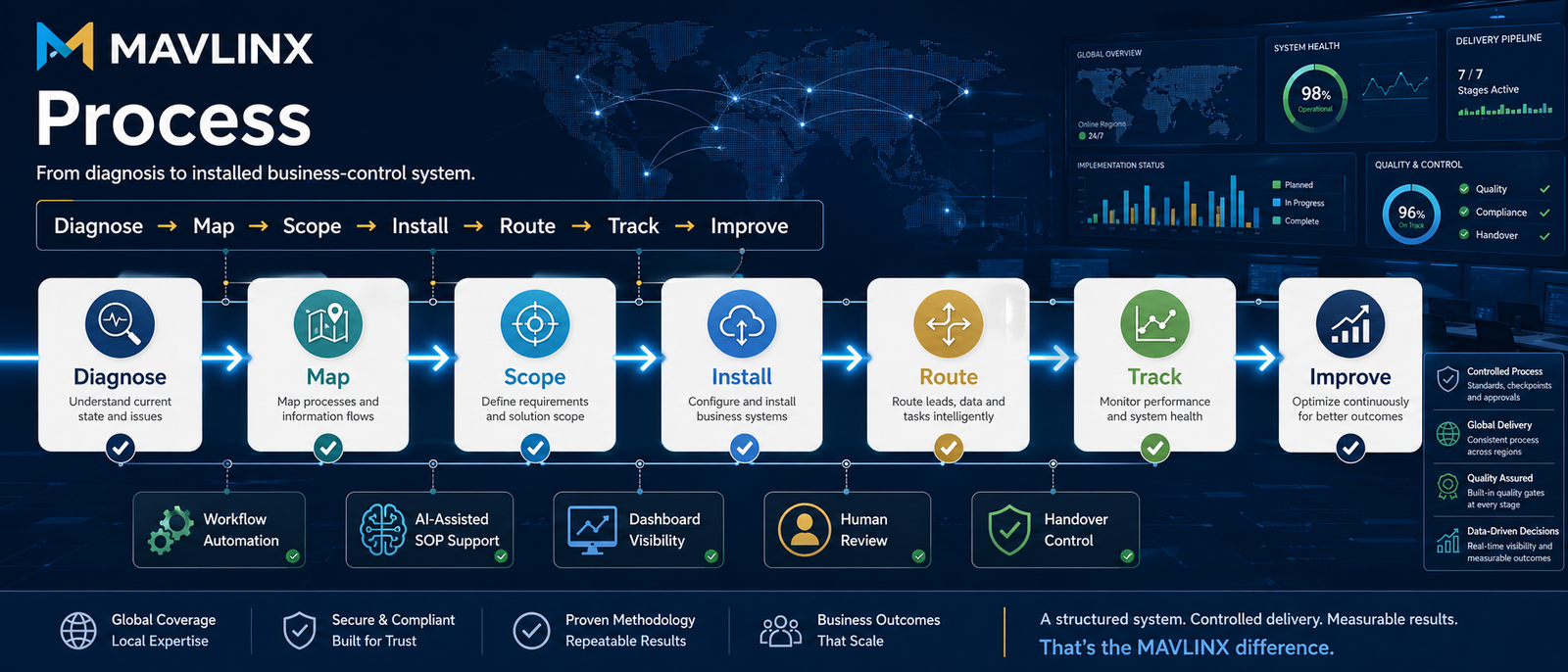
MAVLINX follows a structured process to diagnose, install, route, track, and improve business-control systems.
Most digital work breaks down because the business buys isolated output: a website, a form, an ad, a dashboard, or an automation script. MAVLINX treats the work as an installed business-control system.
Why random digital work breaks down
A page can look premium and still fail commercially. A form can collect inquiries and still lose leads. A CRM can exist and still be ignored. Ads can produce attention and still create no decision visibility.
The missing layer is process control. Before MAVLINX installs a system, the route must be clear: who is the buyer, what leakage is being solved, what data must be captured, who acts next, what gets tracked, and how the owner sees progress.
The process is the quality-control layer
MAVLINX does not start with decoration. The delivery path starts with business leakage, then moves toward system architecture, installation, routing, and visibility.
That is why the Process page exists: to help serious buyers understand how MAVLINX reduces execution risk before they submit a project request.
The MAVLINX model follows a controlled path: classify the buyer, expose leakage, select the correct system, install the control layer, route the next action, and improve after visibility exists.
Classification
We identify whether the need is presence, capture, CRM, SEO, ads, AI workflow, dashboard control, or a custom vertical system.
Architecture
We map pages, forms, CRM fields, routing rules, staff actions, data surfaces, and owner reporting before installation.
Installation
We install the selected system module with capture, routing, tracking, human-review points, and handover logic.
Improvement
Once the business has visibility, the system can be refined through SEO, ads, CRM discipline, dashboards, and workflow review.
This is the practical business systems installation process MAVLINX uses to reduce ambiguity, avoid wrong-fit delivery, and produce usable operating infrastructure.
Diagnose the operating leakage
We identify what is actually broken: weak website presence, lost leads, poor follow-up, scattered WhatsApp activity, unclear staff responsibility, missing dashboards, or weak search/ads routing.
Classify the buyer and system type
The buyer is routed into the right path: Website Installation System, Business Control & CRM Automation, AI Workflow & Operations, SEO Classification, Paid Lead Capture, Growth Control Room, or Custom Vertical System.
Map the system architecture
We define the operating model: pages, forms, fields, lead states, staff assignment, reminders, email/WhatsApp routes, dashboards, reporting surfaces, and human review checkpoints.
Confirm scope and exclusions
Before installation, the scope must be clear. This protects both sides from vague expectations, third-party cost confusion, tool dependency gaps, and uncontrolled feature expansion.
Install the control layer
MAVLINX installs the selected system layer: website structure, lead capture, CRM routing, workflow automation, AI-assisted SOP support, SEO classification, paid lead routes, dashboards, or custom workflow logic.
Test routing and visibility
We review whether inquiries move into the correct route, whether statuses and fields are usable, whether dashboards reflect decision needs, and whether the owner can see what matters.
Handover and improve
The system is handed over with usage logic, route clarity, and improvement direction. Growth work becomes more useful after capture, tracking, and reporting are visible.
MAVLINX process discipline exists to protect commercial usefulness. The goal is not just finishing tasks. The goal is installing a business-control route that can be used after delivery.
The visitor must know whether to request recommendation, installation, CRM setup, funnel build, pricing comparison, or similar custom system.
Forms and inquiry routes should collect useful data, not decorative fields. Every field must support classification, action, or reporting.
Leads must move into status logic, assignment, follow-up markers, and reporting surfaces where the project requires it.
Where AI is relevant, it supports summaries, SOP-based drafting, classification, and decision support with human review.
Pages should communicate search intent, service identity, internal links, metadata, schema, and conversion route.
Owners should see pipeline, activity, status movement, campaign review, or operational summaries where the system requires reporting.
The Process page should not create vague inquiries. It should route each buyer into the right next action based on readiness.
I know the business is leaking, but not what to install.
Use the diagnosis route. This is best when you cannot yet choose website, CRM, AI workflow, SEO, ads, dashboard, or custom system.
- Best for unsure buyers
- Classifies business gap
- Reduces wrong package selection
I understand the system and want implementation.
Use Request Install when you already know the system type and want structured project intake instead of open-ended discussion.
- Best for ready buyers
- Captures project scope
- Moves toward proposal logic
I want to compare budget and package logic first.
Use Pricing when you need to understand package ranges, scope boundaries, and whether MAVLINX is the right commercial fit.
- Best for comparison-stage buyers
- Filters weak-fit leads
- Improves budget clarity
Is the MAVLINX process only for website projects?+
Why does MAVLINX diagnose leakage before recommending a system?+
Does MAVLINX guarantee leads, rankings, sales, or revenue?+
How is AI used in the process?+
What should I do if I am unsure which system I need?+
Start with the right diagnosis before installing another digital asset.
MAVLINX works best when the business gap is classified first. Use the recommendation route if you are unsure, or request installation if you already know the system you need.