SEO Classification System
A SEO classification system is for businesses whose website pages exist, but search engines, AI systems, and buyers do not clearly understand what each page is, who it serves, and where it should route the visitor next.
MAVLINX installs SEO classification and visibility infrastructure: metadata, indexing checks, page intent mapping, schema structure, internal links, service clusters, keyword maps, and conversion routes.
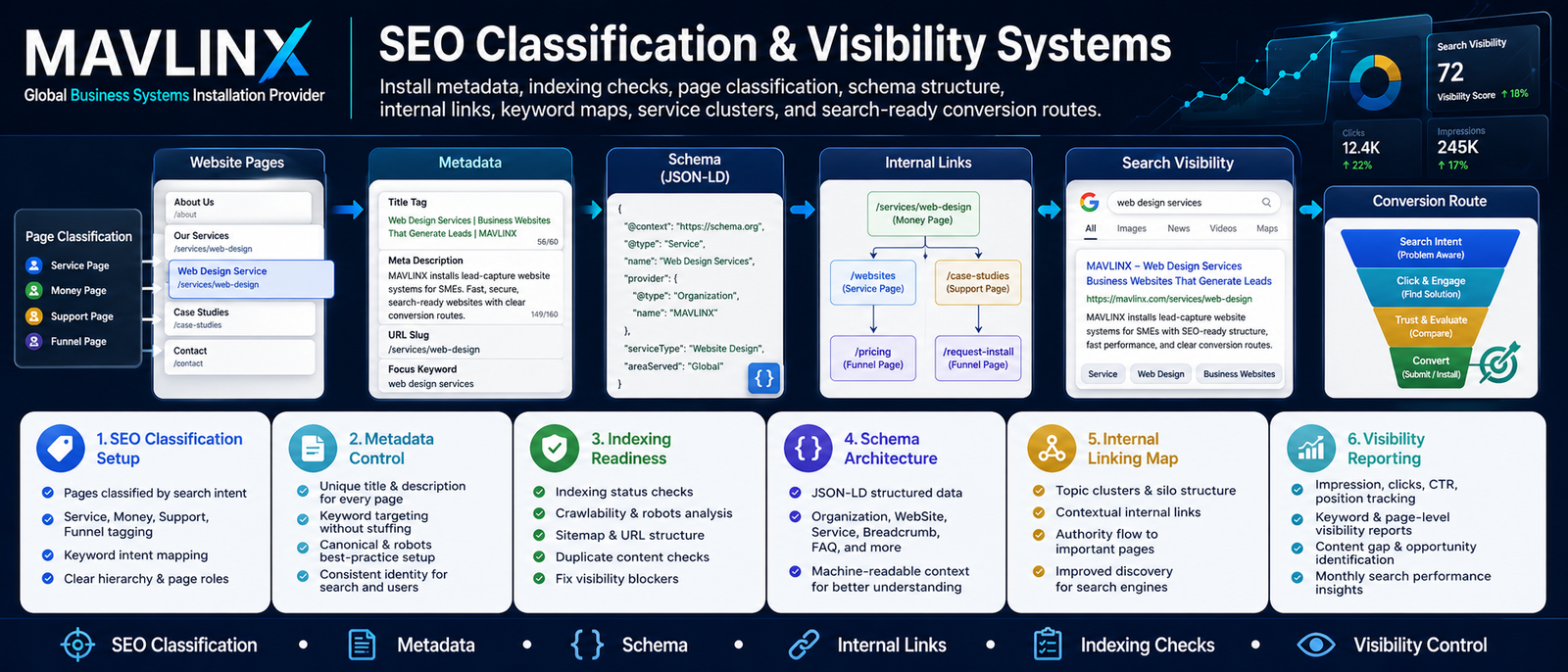
MAVLINX SEO Classification & Visibility Systems — metadata, schema, indexing readiness, internal links, service clusters, and conversion routing.
Most SME websites are not invisible because they lack random keywords. They are invisible because their pages are not classified, connected, structured, or routed in a way search engines and buyers can understand.
Search engines cannot route what your pages fail to classify.
A website can have service pages, blogs, contact forms, images, and nice design — but still fail commercially if each page has unclear intent, weak metadata, missing schema, poor internal links, duplicate signals, or no conversion route.
The non-obvious SEO problem is misclassification.
Many businesses ask for “more SEO” when the real problem is that their site architecture does not tell search engines what the business sells, how services relate, which pages matter commercially, and what a visitor should do next.
MAVLINX does not sell SEO as magic ranking. MAVLINX installs classification, visibility, and search-readiness systems that make each page easier to understand, index, connect, and route.
MAVLINX installs a search-readiness layer that connects page purpose, metadata, schema, internal links, indexing checks, keyword maps, service clusters, and conversion routing.
Metadata Control
SEO titles, descriptions, social metadata, focus keywords, robots, canonical URLs, and breadcrumb titles are aligned.
Schema Architecture
Page-level JSON-LD supports machine-readable classification without duplicating global Organization or WebSite schema.
Indexing Readiness
Indexability, canonical signals, robots settings, thin pages, and structural blockers are checked before scaling content.
Internal Linking Map
Pages are connected to parent pillars, related services, supporting authority pages, and conversion routes.
Keyword & Intent Map
Keywords are used as classification labels tied to buyer intent, not as stuffing or decorative SEO language.
Conversion Routing
SEO pages are built to route buyers into recommendation, install, funnel, CRM, or pricing paths where appropriate.
Choose the right SEO visibility path by structure depth. These are base international installation prices for classification and search-readiness work.
SEO Classification Setup
For a new or small website needing search identity.
- Metadata setup
- Indexing checks
- Page titles
- Basic structure review
SEO System Buildout
For businesses with multiple service pages.
- Keyword map
- Internal links
- Schema setup
- Page classification
SEO Authority Architecture
For serious commercial sites needing structure depth.
- Topical map
- Service clusters
- Schema architecture
- Content briefs
SEO Visibility Retainer
For ongoing visibility improvement and reporting.
- Monthly content review
- Technical review
- Classification improvement
- Visibility reporting
The right SEO path depends on whether your site needs basic classification, multi-page system buildout, authority architecture, or ongoing visibility review.
My site is new or small.
Start with basic classification so the site has proper metadata, indexing readiness, and page identity.
- Metadata setup
- Indexing checks
- Basic page structure
I have multiple service pages.
Use system buildout if your pages need keyword mapping, internal links, schema, and clearer commercial classification.
- Keyword map
- Schema setup
- Internal linking
I need authority structure.
Use authority architecture if your website needs topical depth, service clusters, and content briefs.
- Topical map
- Service clusters
- Content briefs
I need monthly visibility control.
Use retainer support when classification, technical review, content review, and visibility reporting must keep improving.
- Monthly review
- Classification improvement
- Visibility reporting
MAVLINX installs SEO classification in a structured sequence: page purpose first, search signals second, conversion routing third, and ongoing improvement only after visibility logic exists.
Classify current pages
Each page is mapped by commercial role, buyer intent, page type, and conversion destination.
Repair metadata and indexing signals
Titles, descriptions, canonical URLs, robots settings, and indexing blockers are reviewed and corrected.
Install schema and page-level structure
Page-level JSON-LD, heading hierarchy, section logic, and visible FAQ structure are aligned where appropriate.
Build internal links and service clusters
Pages are connected into parent, related, support, and conversion-route patterns that reinforce classification.
Review visibility and improve
SEO becomes a controlled improvement loop based on structure, visibility checks, content review, and route clarity.
Does MAVLINX guarantee Google rankings?+
What is an SEO classification system?+
Is this different from normal SEO?+
Can this work with an existing website?+
Are content writing and ongoing SEO included?+
Make every page easier to classify, index, and route.
SEO is not only about visibility. It is about making your business pages understandable to search engines, AI systems, and buyers — then routing the right visitor toward the right conversion path.